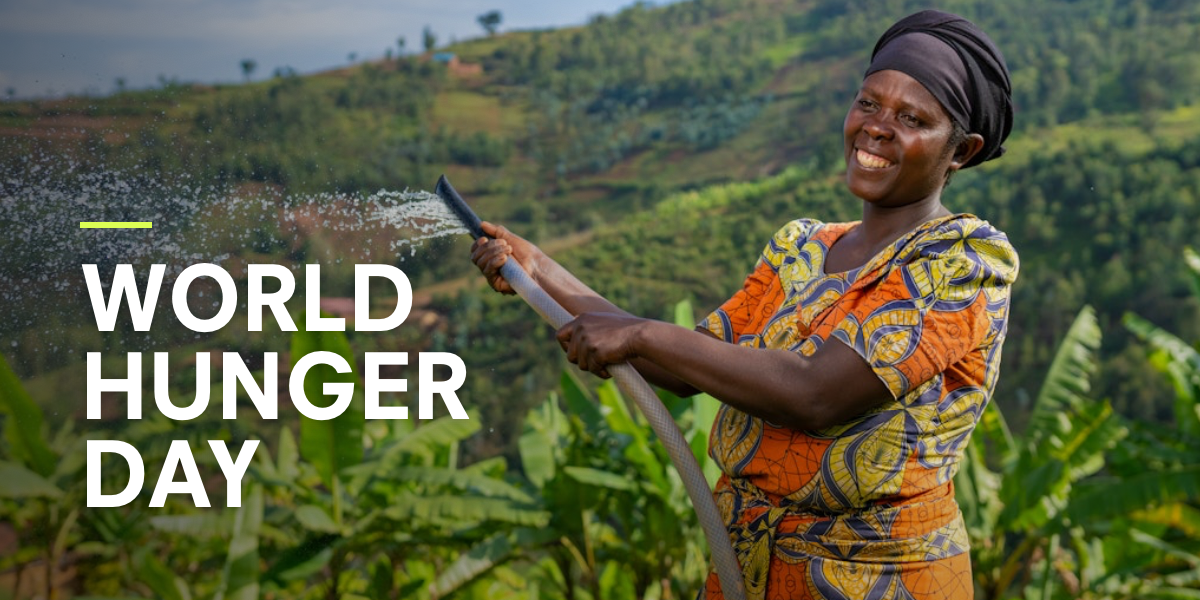
World Hunger Day is observed every May 28. It was launched in 2011 by The Hunger Project to shift the conversation from charity to sustainable solutions — and to highlight the 700+ million people who go to bed hungry every night. In 2026, the day arrives at a moment when global hunger has stalled at historic highs, climate shocks are intensifying, and aid budgets are shrinking. The fastest, most durable way to fight back? Help small-scale farmers grow more food.
That's the work we've been doing for 15 years at The Adventure Project. Here are 10 facts worth knowing this World Hunger Day — and one story from rural Rwanda that captures what's possible when the right solution meets the right moment.
The UN's most recent State of Food Security and Nutrition in the World report estimates that 733 million people faced hunger in 2023 — a number that has barely moved in three years and remains far above pre-pandemic levels. Africa carries the heaviest burden, where roughly 1 in 5 people are chronically undernourished.
According to the Global Report on Food Crises 2025 (released this past May by the Food Security Information Network), about 295 million people across 53 countries and territories experienced acute food insecurity in 2024 — the sixth consecutive annual increase, and the worst figure since the report began tracking.
Beyond outright hunger, roughly 2.33 billion people — more than a quarter of humanity — were moderately or severely food insecure in 2023, meaning they regularly skip meals, eat less, or worry about where their next meal is coming from.
UN Sustainable Development Goal 2 ("Zero Hunger") set 2030 as the target year. At current trends, the UN projects that nearly 600 million people will still be chronically undernourished at the end of the decade.
Alongside conflict and economic shocks, droughts, floods, and erratic rainfall are pushing tens of millions of people into acute food insecurity each year — and weather extremes are now the primary driver in a growing list of countries. In Eastern Rwanda this past year, prolonged dry spells reduced rain-fed harvests and wiped out the household savings many families had built up.
Globally, more than 35 million children under age five suffered from wasting (acute malnutrition) last year. In Rwanda alone, nearly one-third of children under five face chronic malnutrition, stunting their physical and cognitive development for life.
More than 60% of families in sub-Saharan Africa depend on small-scale farming to survive — yet many of those same farmers can't grow enough to feed their own children year-round. The reason isn't lack of effort. It's lack of tools.
Access to a simple foot-powered irrigation pump can boost agricultural productivity by about 400% and allow farmers to grow through the dry season, when food prices are highest. In Kenya and Rwanda, fewer than 6% of farmers currently have that access.
The Adventure Project's longtime partner KickStart International has documented that on average, a small-scale farmer with irrigation grows enough surplus to sell to 50 community members — turning a struggling household into a local food hub.
Over the past 18 months, major international donors have pulled back agricultural programs across East Africa. The most resilient response has been farmer-led: local irrigation markets, rural retail outlets, and "rent-to-try-and-buy" models that don't disappear when subsidies do.
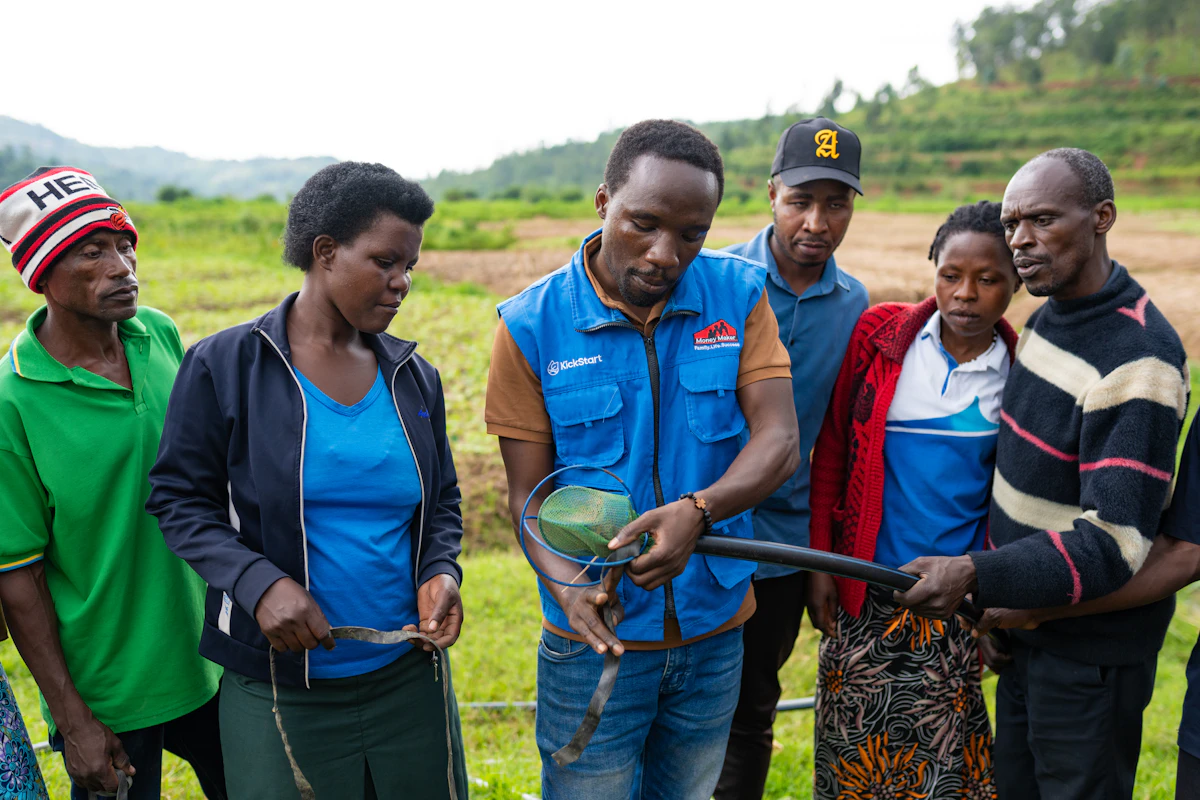
Earlier this year, our team spent nine hours driving across Rwanda — the land of a thousand hills — to a marshland valley in Ruhango. About ten farming families had gathered in a circle, focused on a single object: an irrigation pump.
A KickStart field officer named Faustin demonstrated how it worked. Farmers leaned in. They took turns trying it themselves. The first spray of water shot into the air — and the field erupted in laughter.
That moment is what World Hunger Day 2026 is really about. Not statistics. A choice to invest in people who already know what they're doing.
In Kenya, our partner program now includes 48 trained Irrigation Sales Agents across five counties, who rent affordable pumps to farmers for as little as $0.80 a day — a fraction of what diesel pumps cost. One of them is Linda, an agent outside Kisumu. With three pumps, a seedling nursery, a vertical garden, and a small pig farm, Linda has already repaid one of her pumps, hired a neighbor, and built a business that serves three counties.
In Rwanda, where we've just expanded after 14 years in Kenya, the program is in its first full year. Forty-six farmers are already irrigating through the dry season, and twenty new rural retail outlets have opened — places where, for the first time, families can see, test, and buy a pump without waiting for outside aid. The goal: reach 270 farmers in Rwanda by the end of 2026.
The math is simple. $25 feeds a family. $247 equips one farmer with irrigation and training, who then feeds 50 neighbors. $1,200 hires one Irrigation Agent to launch a rental business that reaches hundreds of farmers in their region.
That's how you end hunger — not by sending food, but by helping the people closest to it grow more of their own.
World Hunger Day is an annual awareness day observed every May 28. It was founded in 2011 by The Hunger Project to shift the global conversation from short-term food aid to sustainable, community-led solutions that end hunger for good.
World Hunger Day 2026 falls on Thursday, May 28, 2026.
The most recent UN data shows that approximately 733 million people experienced hunger in 2023, and roughly 2.3 billion are moderately or severely food insecure. Acute hunger (the most severe stage) reached 295 million people across 53 countries in 2024 — the highest level on record.
The three biggest drivers are conflict, climate shocks (droughts, floods, erratic rainfall), and economic instability, including rising food prices. Climate-related causes have become especially dominant across sub-Saharan Africa, where most families depend on rain-fed agriculture.
Long-term, the most cost-effective solutions are the ones that help small-scale farmers grow more food themselves — particularly irrigation, drought-resistant seeds, and access to local markets. Programs that build farmer-led businesses are far more durable than emergency food aid alone.
Smallholder farmers produce a significant share of the food consumed in low-income countries — yet many can't grow enough to feed their own families because they lack tools, training, and consistent water. Equipping them is the most direct way to increase the local food supply and household income at the same time.
Three of the highest-leverage actions: (1) Share the facts — most people don't know hunger has been rising. (2) Support an organization working on long-term farmer-led solutions, like The Adventure Project's farmer program. (3) Talk to your representatives about protecting agricultural aid budgets, which have been shrinking.
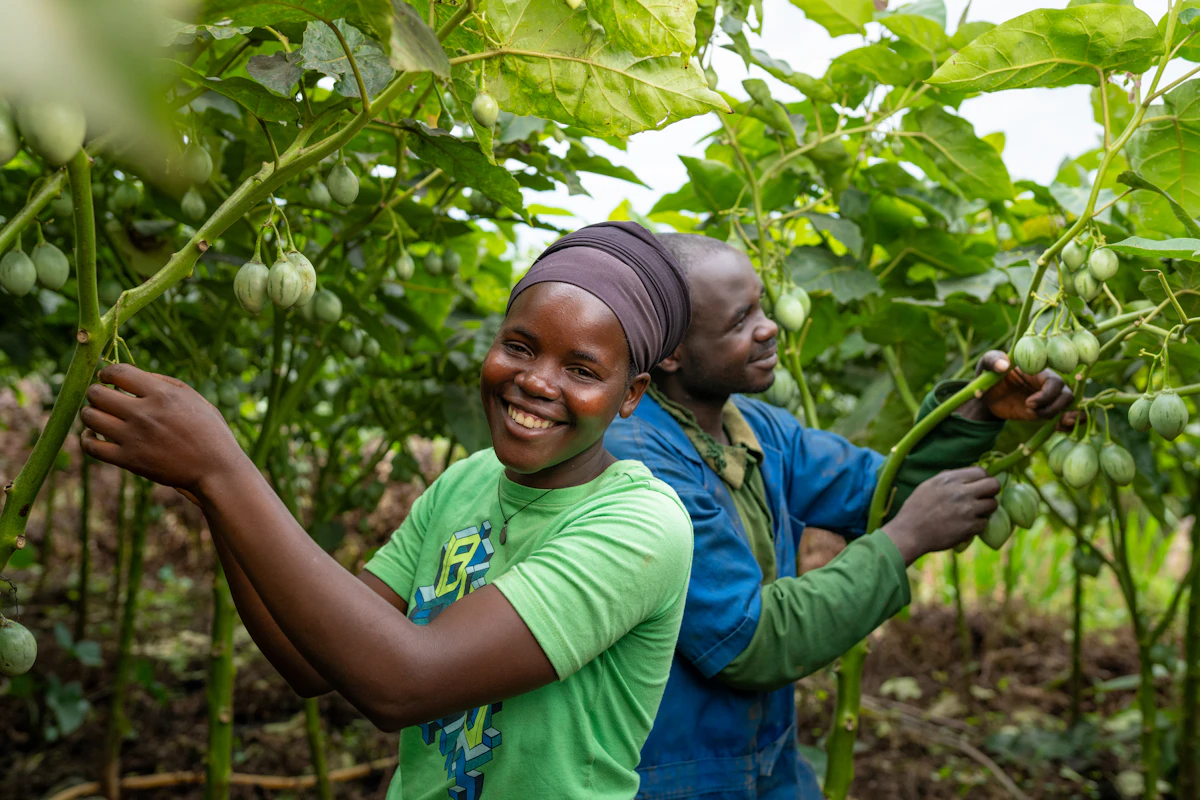
If this post moved you, the most useful thing you can do is share it. Most people still picture hunger as a food shortage problem, when in 2026, it's much more often a tools, training, and climate problem with solutions that already exist.
If you want to go further, you can:
Progress doesn't always look dramatic. Sometimes it looks like water hitting dry soil for the first time. Sometimes it sounds like laughter in a field in Ruhango. Sometimes, it starts with one irrigation pump — and one person who decides to share what they know.
That's worth marking on May 28.

Explore our collection of inspiring blog posts and stories.